
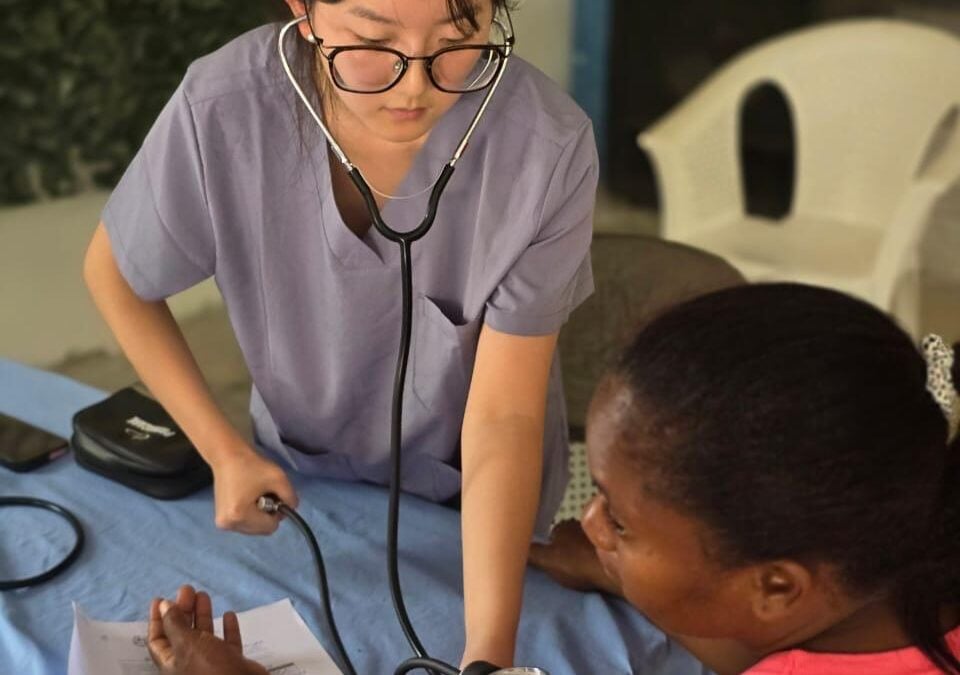
Most pre-med students think of global health as something that happens somewhere else.
A different continent. A different language. A folding table under a tarp instead of an exam room.
But spend a week in a mobile clinic in the Dominican Republic, then spend a week in a critical access hospital in rural Kansas, and something uncomfortable becomes obvious: you are looking at the same problems wearing different clothes.
At Global Health Leaders, this is one of the most common realizations our students describe after returning home. They expected to learn about tropical medicine. What they actually learned was how health systems fail people who live far from them — and that lesson travels.
1. Distance Is a Clinical Variable
In global health, we talk openly about distance. How far is the nearest clinic? Is there a road? Does the road flood?
In the United States, we tend to treat distance as a footnote. It isn’t.
According to Chartis’ 2026 Rural Health State of the State report, 206 rural U.S. hospitals have closed or converted to models that exclude inpatient care since 2010, and 417 more are currently vulnerable to closure. Between 2011 and 2024, 331 rural hospitals stopped offering obstetric services — roughly 27% of rural OB units nationally. Another 448 stopped offering chemotherapy between 2014 and 2024.
The practical result is the same in Kansas as it is in a rural province: a patient in labor, or a patient who needs infusion therapy every three weeks, now has to solve a transportation problem before they can solve a medical one.
When care is two hours away, “available” and “accessible” stop meaning the same thing.
2. The Workforce Gap Is the Same Gap
The World Health Organization projects a global shortfall of roughly 11 million health workers by 2030, concentrated in low- and middle-income countries.
The Association of American Medical Colleges projects a shortage of 20,200 to 40,400 primary care physicians in the United States by 2036.
Different scale. Identical mechanism. Clinicians cluster where there is infrastructure, training capacity, specialist backup, and professional community — and they cluster away from everywhere else.
This is why the clinical texture of rural and global practice rhymes so closely:
- Generalists carry a scope of practice that would be subspecialty work elsewhere
- Nurses, community health workers, and midwives absorb responsibilities well beyond their formal job description
- Referral is a logistics problem, not a phone call
- One clinician leaving town measurably changes population outcomes
A 2019 study found that 64% of Rural Health Clinic staff in the U.S. reported difficulty locating specialists for patient referrals. Any student who has watched a physician in a low-resource setting work the phone for an hour to place one patient will recognize that number immediately.
3. Disease Shows Up Late
When access is hard, patients arrive at the point where symptoms become intolerable rather than the point where disease becomes detectable.
The consequence is measurable. By 2019, rural U.S. areas had a 20% higher death rate than urban areas — up from a 7% gap in 1999. That gap is widening, not closing.
The CDC estimates that in 2022 alone, rural America saw roughly 20,000 preventable early deaths from heart disease and stroke, about 10,000 from unintentional injuries, and approximately 6,000 each from cancer and chronic lower respiratory disease.
The word to sit with is preventable. These are not deaths from exotic pathology. They are deaths from conditions medicine already knows how to manage — when it reaches people in time.
That is the same sentence global health has been repeating for forty years.
4. Chronic Disease Is the Common Denominator
There is a persistent assumption among pre-med students that global health means infectious disease and rural American health means opioids.
Both are real. Neither is the main story anymore.
Four of the five leading causes of death in rural America are chronic diseases. Across low- and middle-income countries, hypertension, diabetes, and cardiovascular disease have been climbing for two decades while infectious disease mortality has fallen.
This is why a blood pressure cuff is the most-used instrument in almost every clinic our students work in, on either side of the map. Chronic disease management is fundamentally a continuity problem — it requires a patient to be seen repeatedly, reliably, over years.
Continuity is precisely what both settings struggle to provide.
5. Trust and Language Decide Whether Care Works
Students often expect the language barrier abroad. What surprises them is discovering the same barrier at home.
In both settings, the determining factors are remarkably similar:
- Whether the clinician is from the community, or visiting it
- Whether past encounters with the health system went badly
- Whether advice is compatible with the patient’s actual work, income, and household
- Whether anyone explained the plan in words the patient uses themselves
“Take this twice daily with food” is not clinical advice if the patient’s food supply is inconsistent. That is equally true in a batey outside Santo Domingo and in a county in Appalachia.
Where the Two Contexts Genuinely Differ
Drawing the parallel too far would be dishonest, and students should be able to articulate the differences as clearly as the similarities.
- Financing. Rural American health systems fail largely through reimbursement structures and thin operating margins. Many global settings are constrained by absolute resource scarcity — a different problem requiring different solutions.
- Insurance. In 2020, 17.9% of rural U.S. adults were uninsured, the highest of any geographic category. Coverage gaps are a distinctly American failure mode.
- Infrastructure baseline. Reliable electricity, clean water, and cold chain are assumptions in most of rural America and open questions elsewhere.
- Disease profile. Endemic infectious disease and vector-borne illness still shape clinical practice abroad in ways they generally do not domestically.
The honest framing is not “these are the same.” It is that the structural logic of underserved care — distance, workforce, continuity, trust — is shared, while the causes and constraints are not.
Why This Matters for Pre-Med Students
Admissions committees read a great many personal statements about international experience. The ones that land are rarely the ones describing how meaningful the trip felt.
They are the ones that demonstrate transferable clinical reasoning.
A student who can explain why a hypertension follow-up plan fails for the same structural reasons in two different countries is showing something a committee actually wants to see: the ability to reason about systems, not just about patients.
That skill also happens to be the one that makes a good physician anywhere. Roughly 20% of Americans live in rural areas. Most physicians will treat patients affected by access barriers regardless of where they ultimately practice.
Final Thought
Global health is not a geography. It is a way of thinking about who medicine reaches and who it misses.
Students who understand that come home from an international placement with more than a story. They come home with a framework they can apply in a clinic three counties from where they grew up.
The folding table looks different. The problem underneath it usually doesn’t.